
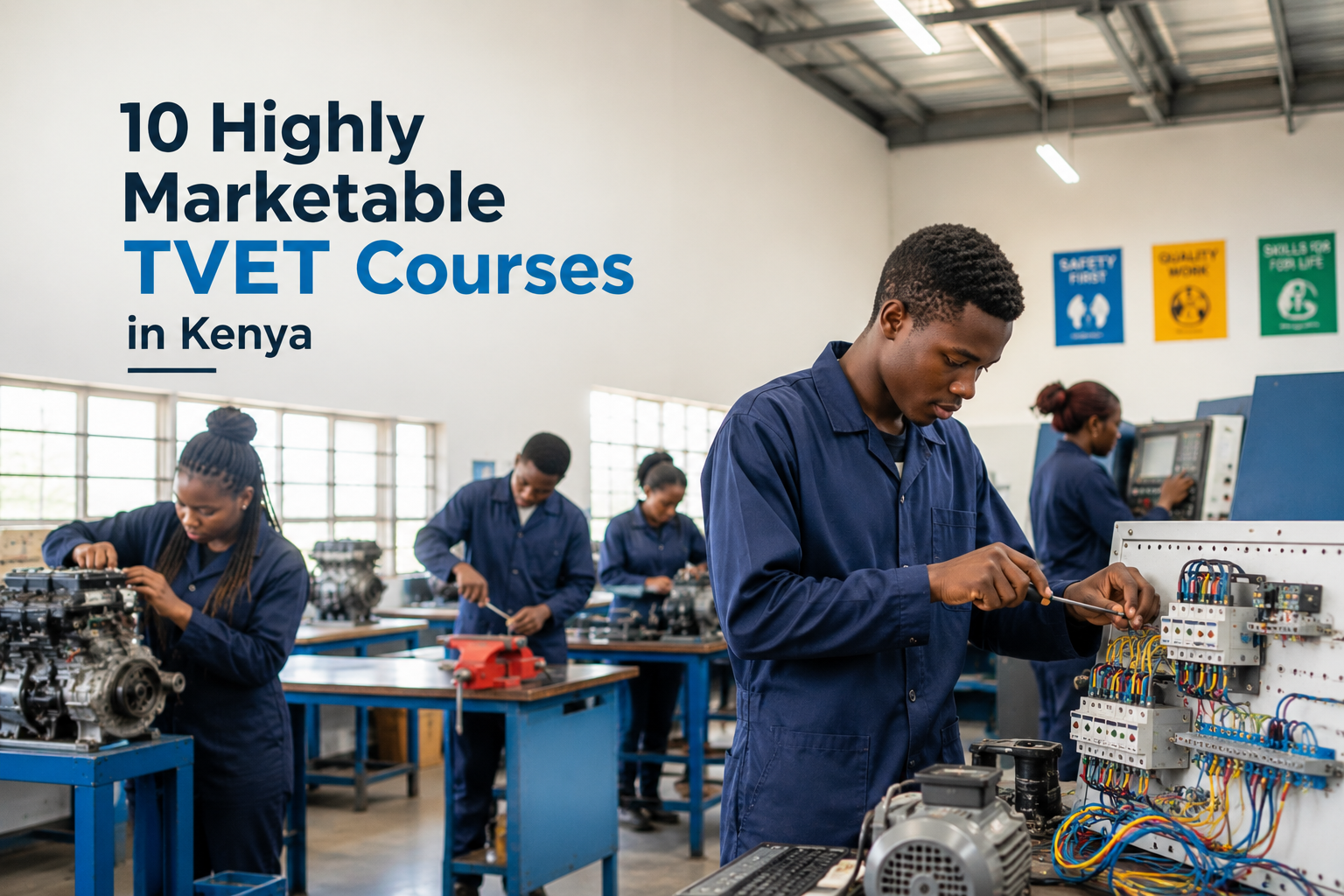
The Technical and Vocational Education and Training (TVET) sector in Kenya has experienced a significant growth over the past decade. As industries evolve and employer expectations shift toward practical skills, TVET qualifications are increasingly recognized as direct pathways to meaningful employment and career growth.
Whether you're a recent KCSE graduate, a parent exploring education options for their children or someone who is looking to upskill, choosing the right course to study is one of the most important decisions you will make in your education journey.
In this article, we will explore some of the most marketable TVET courses in Kenya and why they offer promising career opportunities.
- Information Technology and Software Development
The digital transformation of Kenya’s economy continues to accelerate across all sectors. Organizations in finance, healthcare, agriculture, and government require skilled professionals to manage networks, develop software applications, and safeguard data systems. TVET programmes in information technology equip students with practical competencies in programming, database management, and systems administration. Graduates find opportunities in formal employment, remote international contracts and in entrepreneurship. Strong foundations in mathematics and analytical reasoning are advantageous for success in this field.
2. Clinical Medicine and Health Sciences
Healthcare remains an essential sector with consistent demand for qualified practitioners. Clinical officers serve as primary care providers in hospitals, health centers, and community programmes across the country. A diploma in clinical medicine prepares graduates to diagnose and manage a wide range of medical conditions, making them essential to both public and private health systems. This qualification provides a strong job security making it easy to specialize and advance through hands-on experience and continuous learning.
3. Nursing
Nursing is one of the most marketable diploma courses in Kenya today. Kenyan nurses are employed locally in hospitals, clinics, and community health programmes, and are also actively recruited by healthcare institutions abroad. Specializations in critical care, theatre nursing, and midwifery enhance employability and earning potential. The profession demands compassion, resilience, and a commitment to patient welfare, but it rewards practitioners with enduring job security and opportunities for global mobility.
4. Electrical Installation and Solar Energy Technology
Kenya’s infrastructure development and renewable energy expansion have created sustained demand for skilled electrical technicians. Professionals trained in electrical installation and solar technology are required in residential construction, commercial projects, and rural electrification initiatives. This field offers flexibility, as graduates may seek formal employment with construction firms and energy companies or establish independent contracting businesses. The trade is particularly suited to individuals with strong practical aptitude and an interest in problem-solving through hands-on work.
5. Pharmaceutical Technology
The pharmaceutical sector requires competent technicians to support dispensing, inventory management, quality assurance, and regulatory compliance. Pharmacy technicians are employed in hospital pharmacies, retail chemists, and pharmaceutical manufacturing facilities. As the healthcare system expands and regulatory standards tighten, the demand for formally trained pharmacy professionals continues to grow. This course is well-suited to individuals with a meticulous nature and an interest in the science of medication and patient care.
6. Building and Construction Technology
Urbanization and infrastructure investment have sustained robust activity in Kenya’s construction industry. Technicians trained in building technology, quantity surveying, and site supervision are essential to ensuring that projects are completed safely, on schedule, and within budget. Graduates may work with construction firms, government agencies, or private developers. With experience and professional registration, many progress into project management or establish their own contracting enterprises. This field rewards precision, leadership capacity and the ability to coordinate complex logistical operations.
7. Supply Chain Management and Procurement
Effective procurement and logistics management are vital to organizational efficiency across both public and private sectors. Professionals in this field are responsible for sourcing goods and services, managing vendor relationships, optimizing inventory and ensuring timely delivery of materials. A diploma in supply chain management prepares graduates for roles in procurement departments, logistics firms, manufacturing companies and international trade operations. The discipline suits individuals who are organized, numerate, and capable of strategic negotiation.
8. Mechanical and Automotive Engineering
Industrial and automotive sectors depend on technicians who can maintain, repair, and optimize machinery and vehicles. Training in mechanical engineering or automotive technology prepares graduates for roles in manufacturing plants, transport companies, mining operations, and independent workshops. The field encompasses everything from precision machining to heavy equipment operation. It is ideally suited to individuals who enjoy working with physical systems and diagnosing mechanical failures.
9. Hospitality and Culinary Arts
Kenya’s tourism and hospitality industry remains a significant contributor to the national economy, requiring trained professionals in food production, accommodation management, and guest services. Diplomas in hospitality management and culinary arts prepare students for careers in hotels, restaurants, resorts and event management companies. The field also offers strong entrepreneurial potential, as graduates may establish catering businesses, bakeries, or consultancy services. Success in hospitality depends on creativity, attention to detail and great interpersonal skills.
10.Welding, Fabrication and Plumbing
Traditional trades continue to play a vital role in construction, manufacturing and infrastructure development in Kenya. Skilled welders, fabricators, and plumbers are consistently in demand for building projects, industrial installations, and repair services. These trades offer immediate employability and significant entrepreneurial potential, as experienced practitioners often establish independent service providers. The work is physically demanding but financially rewarding for those who develop expertise and build reliable professional reputations.
How to Choose the Right Course for You
While market demand is important, choosing a course should also depend on:
- Your interests and strengths
- Career goals
- Industry trends
- Practical skill requirements
- Opportunities for further education
- Self-employment potential
A course that aligns with your passion and abilities is more likely to lead to long-term career satisfaction.